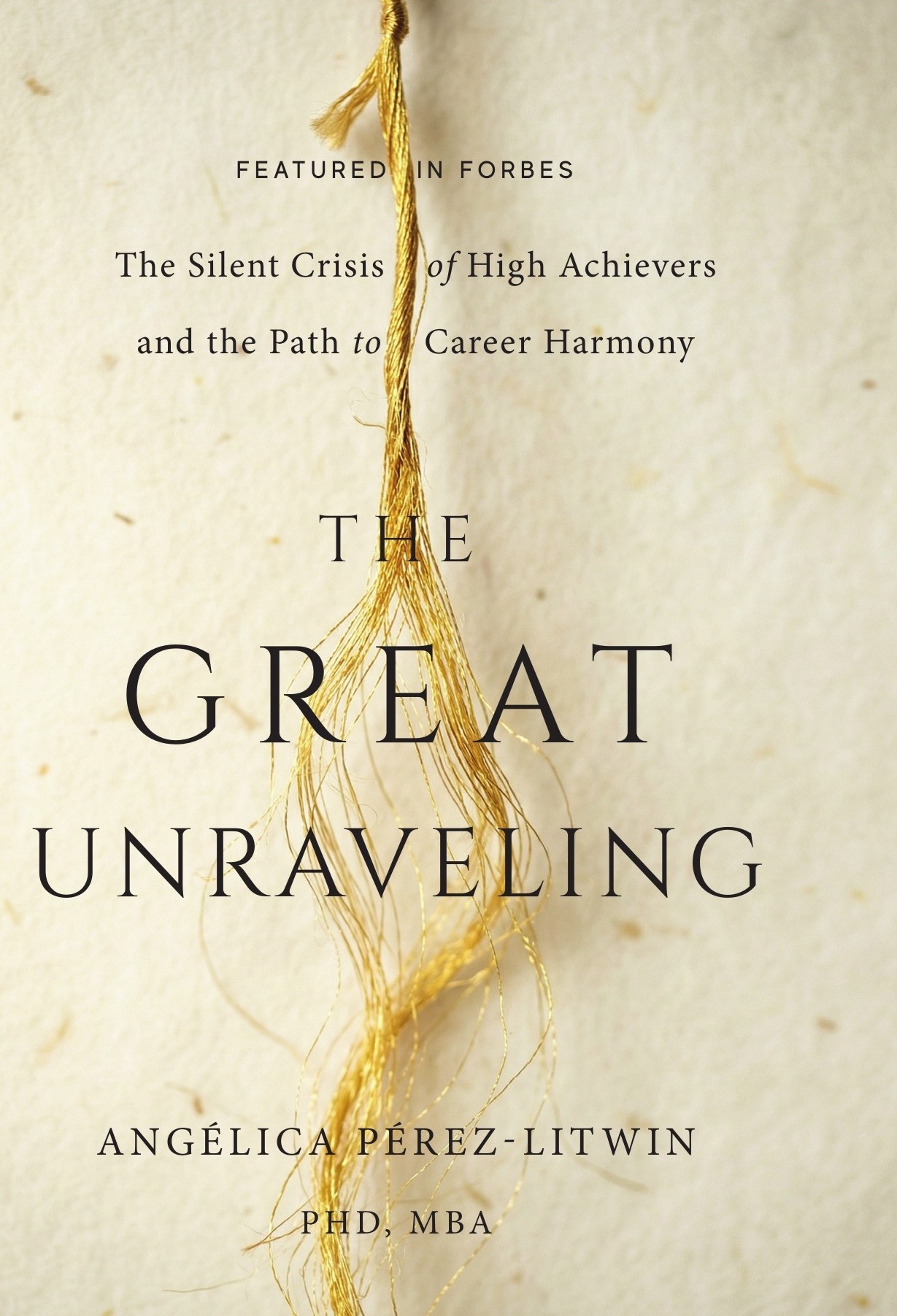
Featured in Forbes

Now available

You’re successful by every measure.So why are you quietly falling apart?

You can’t stop thinking about work—even when you’re with the people you love. A meeting that didn’t go well replays in your mind for days. You feel worthy when you’re accomplishing something. You’re always on.

We keep calling it burnout. But for some high achievers, something deeper is happening.

In The Great Unraveling, clinical psychologist Dr. Angélica Pérez-Litwin gives a name to the pattern burnout language has missed—and shows high achievers how to build success without losing themselves in the process.

Get the book

Available now on Amazon

Your career looks good. So why doesn’t your life feel better?

You’re doing well. You may even love parts of your job. But underneath the accomplishments, something feels off.

Your mind is never quiet. You keep taking on more, even when you’re already stretched too thin. You want to enjoy the life you’ve worked so hard to build, but you’re often too overwhelmed, distracted, or exhausted to be fully in it.

And maybe the most confusing part is that you’re not necessarily unhappy with your job.

You may be accomplished, well-compensated, and doing everything you’re supposed to be doing. But there is a dissatisfaction simmering beneath the surface.

You wonder whether you need a different career—or whether you could feel fulfilled in the one you already have.

Your life looks good. So why doesn’t it feel better than this?

The Great Unraveling explores what may be happening beneath the success—and how to begin building a healthier relationship with work.

Get the book

Available now on Amazon

What if burnout isn’t the whole problem?

WHAT IF BURNOUT ISN’T THE WHOLE PROBLEM?

You keep trying to feel better. But nothing seems to change for very long.

You take the vacation.

Promise yourself you’ll set better boundaries.

Try to say no more often.

Make another list. Block time on your calendar. Tell yourself you’ll get organized and stop taking on so much.

Maybe you try meditation, find something that helps you slow down, or make more time for the things you enjoy.

Maybe you’ve tried changing the work itself—finding something more interesting, taking on a new challenge, or even leaving to start something of your own.

And sometimes it helps.

For a while.

Then the same patterns begin to return.

You’re overwhelmed again. Your mind is constantly planning, problem-solving, or thinking about what needs to happen next.

You say yes when you meant to say no.

You’re checking work when you wanted to be present.

You’re exhausted, but the thought of returning to full speed after time away brings its own kind of stress.

And you begin wondering whether the problem is your job, your habits, your inability to set boundaries, or something you still haven’t figured out.

Maybe you don’t need another productivity system.Maybe you don’t need to care less.Maybe you don’t even need to leave the career you’ve worked so hard to build.Maybe you’ve been trying to solve the wrong problem.

The cost of waiting

THE COST OF WAITING

Because this doesn’t always stay at work.

When work and achievement occupy this much psychological space, the cost can begin to show up in more places than you expected.

In your life.

You feel anxious, even when nothing is obviously wrong.

You lie awake thinking about work. Or you sleep, but wake up feeling as though you never really rested.

You’re physically present with the people you love, but your mind is somewhere else.

The things you once enjoyed get pushed aside. Your life becomes increasingly organized around work, responsibilities, and recovery from both.

You may find yourself more irritable, emotionally exhausted, or simply too depleted to enjoy the life you’ve worked so hard to build.

And sometimes, in your career, too.

You become more reactive to things that once would not have affected you as much.

A difficult conversation, unexpected request, or piece of feedback can leave you feeling overwhelmed or emotionally unsettled.

You may find it harder to think clearly, prioritize, or make decisions with the confidence you once had.

You feel less present and grounded in meetings. You second-guess yourself. You worry about how you will perform—or whether anxiety might become visible when you need to be at your best.

The leader who once felt calm and capable may begin to feel flustered, distracted, or less able to show up the way they want to.

And sometimes, other people begin to notice.

Not because you have stopped caring.

But because you have been carrying too much for too long.

You have built an extraordinary career around a life you are barely experiencing.

This is why simply pushing through isn’t always neutral.

The longer work occupies this much psychological territory, the more it can affect your wellbeing, your relationships, your confidence, and the way you show up professionally.

You don’t have to wait until something falls apart to change it.

There may be a name for what you’re experiencing

It’s not always burnout.

For more than two decades, clinical psychologist Dr. Angélica Pérez-Litwin has worked with accomplished professionals who appeared successful by every external measure—and were quietly struggling underneath it.

Physicians. Attorneys. Executives. Founders. Leaders.

Again and again, she encountered people whose experiences weren’t fully explained by burnout.

They weren’t simply tired.

They were overwhelmed, emotionally exhausted, and struggling to switch off—even when work was going well.

Some were beginning to lose confidence in the very careers they had worked so hard to build.

Others were questioning whether they needed to leave their jobs, when what they really wanted was to feel better in the lives they already had.

And for some, the same patterns followed them from one career or business to the next.

What connected these experiences was not simply the amount of work.

Work had become psychologically personal.

A difficult meeting could feel like more than a difficult meeting.

Slowing down could bring anxiety rather than relief.

Success could feel necessary, but never quite sufficient.

And changing jobs didn’t always change the pattern.

Dr. Pérez-Litwin gave this pattern a name:

Career Distress Response™

The Great Unraveling explores what happens when career, achievement, identity, and self-worth become so psychologically entangled that work stops being simply something you do—and begins shaping how you experience yourself.

But the book doesn’t just name the pattern.

It helps you understand what may be happening beneath your success—and how to begin changing your relationship with work.

Early praise

Finally, language for something so many high achievers experience but rarely talk about.

Dr. Angélica Pérez-Litwin gave a name to a pattern I'd been witnessing for years but could never fully explain. Some books teach you something new. Others change the way you see yourself. This one does both.

Pamela Slim

Author of Body of Work and The Widest Net

"Burnout" never quite fit what I was witnessing—in myself, and in the hundreds of C-suite leaders I've placed over my career. I had no language for it until this book. The crisis Dr. Pérez-Litwin describes is real, widespread, and hiding in plain sight.

Andrea Henderson

Executive Talent Strategist, Global Search Firm Partner

Dr. Pérez-Litwin offers language and insight that I believe will become foundational in how we understand the intersection of work, career, identity, and well-being. I can envision this work shaping how future psychologists are trained.

Tatiana Vera, PsyD

Licensed Clinical Psychologist

The question beneath the question

Why does work have this much power over how you feel?

  • Why can one person’s criticism undo an entire day?
  • Why can a promotion feel euphoric on Friday—and strangely insufficient by Monday?
  • Why is it so difficult to stop thinking about work when you desperately want a break from it?
  • Why can slowing down feel uncomfortable instead of restorative?
  • Why can changing jobs—or even starting something of your own—fail to resolve the same dissatisfaction?
  • And why, after achieving so much of what you once wanted, can you still feel as though you haven’t done enough?

These aren’t simply questions about productivity.

They’re questions about the psychological relationship you’ve developed with work, achievement, success—and yourself.

The Great Unraveling takes you beneath the symptoms to understand why these patterns develop, why they can be so difficult to change, and how to begin building a healthier relationship with work.

Because understanding what is happening is the first step toward changing how you experience your career—and your life.

What you’ll discover

This book may change the way you understand your relationship with work.

Why you can’t switch off

Why your workday can end while your mind keeps working—and why rest alone may not solve it.

Why success never seems to feel like enough

Why accomplishment can create a temporary high without delivering the lasting sense of security or satisfaction you expected.

Why work feels so personal

Why criticism, uncertainty, exclusion, mistakes, and professional setbacks can affect you far more deeply than the situation seems to warrant.

Why changing jobs doesn’t always change the pattern

How the problem we attribute entirely to a workplace can sometimes follow us into the next role.

What you may have lost along the way

How achievement can slowly crowd out relationships, interests, pleasure, rest—and parts of yourself you once knew well.

How to keep your ambition without losing yourself

A different way to think about work, achievement, identity, and success—so your career can remain important without becoming your entire life.

What becomes possible

Imagine feeling successful—and actually enjoying your life.

Life outside work

Imagine finishing the workday and being able to leave it behind.

Taking a true vacation without constantly checking in.

Sitting across from someone you love and actually being there.

Having the energy to enjoy the things you used to love—not just recover from work.

Saying no without feeling guilty. Making choices about your time instead of feeling that everything is a priority.

Confidence and fulfillment at work

Feeling calm and confident in meetings again. Thinking clearly. Making decisions without constantly second-guessing yourself.

Being able to recognize what you’ve accomplished instead of immediately feeling that you should do more.

Doing work that uses your strengths and makes you feel alive.

Knowing whether you want to stay in your career, make changes, or pursue something new—and being able to move toward that decision without burning yourself out.

A healthier relationship with success

Pursuing a goal because it excites you, not because achieving it will finally make you feel like enough.

Being ambitious without living in constant overdrive.

Being successful without needing success to tell you who you are.

You don’t have to choose between achievement and a life.

There is another way to relate to work.

A different kind of career book

This isn’t a book about lowering your ambition.

And it isn’t another prescription to meditate more, manage your time better, take a vacation, or establish perfect boundaries.

Those things can help.

But what if you’ve tried them—and you still find yourself overwhelmed, unable to switch off, or wondering why the career you worked so hard to build doesn’t feel the way you expected?

The Great Unraveling goes underneath those experiences.

It explores the psychological relationship between work, achievement, identity, and self-worth—and offers a practical path toward changing it.

Part psychology.

Understand why work can affect you so deeply.

Part self-discovery.

Recognize the patterns that may be shaping your experience.

Part roadmap.

Begin building a healthier relationship with work and a life that feels more like your own.

How do you build a successful career without losing yourself in the process?

Get the book

The path forward

Your career should be part of a rich life.Not the price you pay for one.

Dr. Pérez-Litwin calls the destination Career Harmony.

It’s about building a healthier relationship with work—one that allows you to pursue meaningful goals without sacrificing your wellbeing, relationships, or the parts of life that make you feel like you.

Your career can matter enormously.

But it doesn’t have to occupy your entire life, determine your worth, or leave you too exhausted to enjoy what you’ve worked so hard to build.

You can care deeply about your work and still have room for rest, relationships, creativity, and a life beyond achievement.

The Great Unraveling shows you how to begin.

Inside The Great Unraveling

From unraveling to a different way of living.

Part One

The Silent Crisis of High Achievers

Understand what may actually be happening beneath the exhaustion, overthinking, pressure, and relentless drive.

Part Two

The Path to Career Harmony

Begin changing the patterns that have allowed work and achievement to occupy too much of your identity and life.

Part Three

When Life Gets Complicated

Learn how to navigate the moments when career and identity are most likely to collide—including misalignment, major transitions, job loss, and parenthood.

Praise for The Great Unraveling

What leaders, clinicians, and coaches are saying

In leadership, we often celebrate achievement without fully acknowledging its human cost. The Great Unraveling brings clarity and compassion to that reality, offering a deeply insightful framework for understanding the internal pressures many high achievers carry.

Nathalie Rayes

Former U.S. Ambassador to Croatia

Reflecting intellectual rigor and hard-earned wisdom, this book provides a practical framework for greater self-awareness and personal growth. A timely and important contribution for physicians, advanced practice providers, and healthcare leaders.

Francine R. Gaillour, MD, MBA, PCC

Executive Director, Physician Coaching Institute

Dr. Pérez-Litwin's Career Distress Response model is directly applicable to so many of my high-achieving coaching clients. I believe these ideas have the potential to become foundational for how coaches support high-achieving professionals.

Laura Welch Nevarez, MBA, PCC

Founder, Anavah Leadership

Dr. Angélica Pérez-Litwin, clinical psychologist and author

About the author

Dr. Angélica Pérez-Litwin, PhD, MBA

Dr. Angélica Pérez-Litwin is a clinical psychologist, author, and founder of the Career Health Institute.

For more than two decades, she has worked with high-achieving professionals—including physicians, attorneys, executives, founders, and other accomplished leaders—navigating the hidden psychological costs of career success.

Her work focuses on an increasingly urgent question:

What happens when the career we worked so hard to build begins taking more from our lives than it gives back?

Her work on Career Distress Response™, Career Identity Fusion, and Career Harmony offers a new lens for understanding the complicated relationship between achievement, identity, well-being, and success.

Dr. Pérez-Litwin earned her BA in Psychology from Columbia University, a PhD in Clinical Psychology, and an MBA in Innovation and Entrepreneurship. She has appeared in Forbes, The Today Show, NPR, and other media.

Learn more about Dr. Pérez-Litwin →

You don’t need to wait for a crisis

Your career looks good on the outside.Now make it feel as good as it looks.

You can care deeply about your work and still want more from your life.

More time to be present with the people you love. More energy for the things you enjoy. More freedom to make choices about your career without feeling that everything you’ve built is at stake.

You may want to stay in your career and finally feel better in it.

Or you may be ready to explore something new—without repeating the same cycle of overwork, exhaustion, and starting over.

You don’t have to be falling apart to read this book. You only have to recognize that success shouldn’t cost this much.

The Great Unraveling helps you understand what may be happening beneath your success—and how to begin building a healthier relationship with work.

Get the book

Available on Amazon

332 pages · Illumify Media

The Great Unraveling book cover

The Great Unraveling